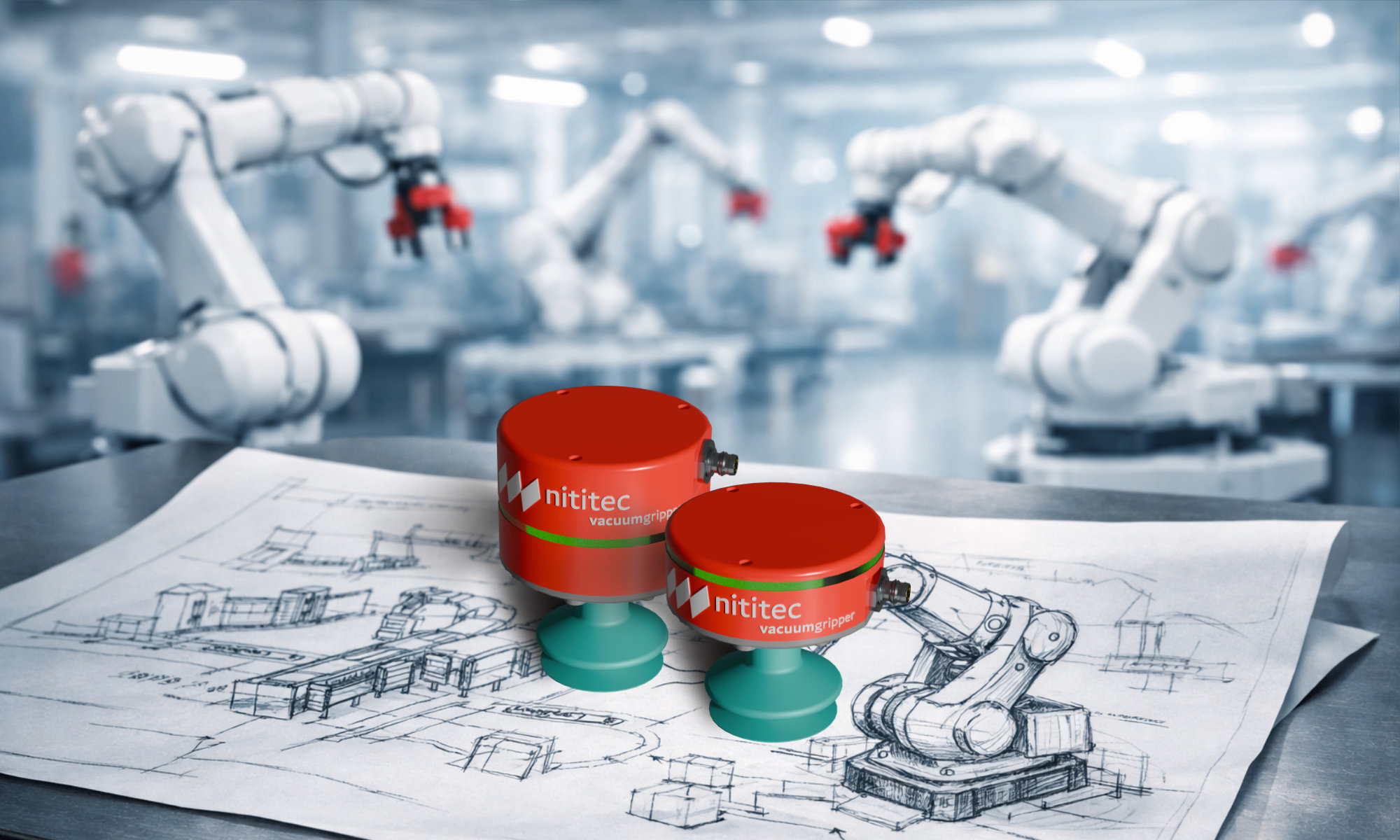
At the 2026 ZVEI Electrifying Ideas Award, ZeMA’s fully electric gripping technology made it to the top three finalists. It did not win. At first glance, a small vacuum gripper seems rather unremarkable next to the big issues of industrial energy efficiency. But that is precisely where its story lies: What may seem insignificant at a single gripping point is repeated millions of times in automated systems. And, of all things, an energy source that has been taken for granted for decades is rarely questioned in principle: compressed air.
Reaching the finals was not without impact. A company that is now discussing a specific application with nititec vacuum gripper first became aware of the technology through the award. It wasn’t the first time someone had taken a closer look. Eight years earlier, something similar happened at the Hannover Messe.
From Smart Wires to Vacuum Grippers
It didn’t start with a gripper, but with research. At Saarland University and within the ZeMA research network, Prof. Stefan Seelecke and Prof. Paul Motzki were studying shape-memory alloys and exploring how their unique properties could be harnessed for compact mechatronic drives.
Nickel-titanium plays a central role. When a thin wire made of this alloy is heated by a short electrical pulse, its internal structure changes and it shortens. In the process, it generates surprisingly high forces within a very small space.
This research gave rise to various drive concepts. One of them led to vacuum gripping.
Volkswagen saw the first prototype featuring this technology at the 2018 Hannover Messe and took notice. At that time, it was not yet foreseeable that a company would emerge from it years later. But one question was on the table: Could the research principle be used to develop a gripping technology that works under industrial conditions?
The basic physical concept behind it is surprisingly old.
Actually, any suction cup can do it
No one needs to connect a suction cup on a glass pane to a compressed air line. You press it against the surface, air escapes, the volume is sealed, and the resulting pressure difference holds it in place. Everyone knows this principle. So why, when it comes to automated vacuum gripping, have people been thinking for decades about how the vacuum is generated? Most often with compressed air and an ejector?
The answer lies less in physics than in automation. A person presses a suction cup against the glass and later pulls it off at the edge. A robot cannot do that. It needs a repeatable technical sequence. When the suction cup is applied, air must escape as quickly as possible. Afterward, the system must close and reliably maintain the vacuum during movement. At the release point, air must be allowed to re-enter just as quickly so that the component is released immediately.
And not just once. But ten, twenty, or thirty times per minute. Here, a simple physical principle became an engineering challenge.
Switch. And then do nothing more
For the switching process, the researchers used a nickel-titanium actuator. A short electrical pulse heats the shape-memory wire. It shortens and generates the force with which the system changes its state.
The greater challenge lay in maintaining this state afterward. The design had to be able to reliably assume two stable switching states without requiring a constant supply of energy. The developers refer to this as bistability.
Some worked in principle but proved not to be robust enough. Others were too complicated to later develop into a scalable product. At this point, the research team had to do something that is part of everyday life in development departments: let go of ideas, even though they were technically interesting.
Then the team found the solution that proved to be both robust and scalable. This did not yet turn an interesting property of a smart material into an industrial gripper. But one of the key hurdles had been cleared.
Volkswagen Turns Research into an Industrial Project
A few years after the initial contact at the Hannover Messe, a joint research project between the ZeMA Institute in Saarbrücken and Volkswagen was launched as part of Volkswagen’s “Factory of the Future” initiative.
Now the bar had been raised.
It was no longer enough to demonstrate that a gripping principle worked in the lab. The bistable concept had to be tailored to the specific requirements of an automaker: mechanics, leakage, safety, electronics, and interfaces were all part of the equation, as was the question of whether a reproducible gripping cycle could even be established from it.
At the time, Yannik Goergen was a group leader at the department and oversaw the project as project manager. The result was a gripping system with four grippers. It picked up a door panel, moved it, and set it down again—all electrically—about ten times per minute.
It wasn’t a production-ready product yet. But the gripper had left the lab.
The project demonstrated that the pneumatic-free principle could be applied to a real-world industrial gripping task. A research question had turned into a functioning gripping system.
“There seems to be a market here”
Technical feasibility and a viable business model are two different things. For Goergen, the second important signal therefore came once again from Volkswagen. The automaker provided the team with extensive support in their search for investors and established contacts with suppliers. This changed their perspective on their own development. “There seems to be a market out there,” Goergen says today, describing that moment.
Nevertheless, there was still a long way to go before it actually became a company. In mid-2025, nititec vacuum gripper was spun off as a startup, backed by a technology investor to support the further development of technology and products.
The research project was complete. The development of the gripper was not.
Without a pump—or with a reserve
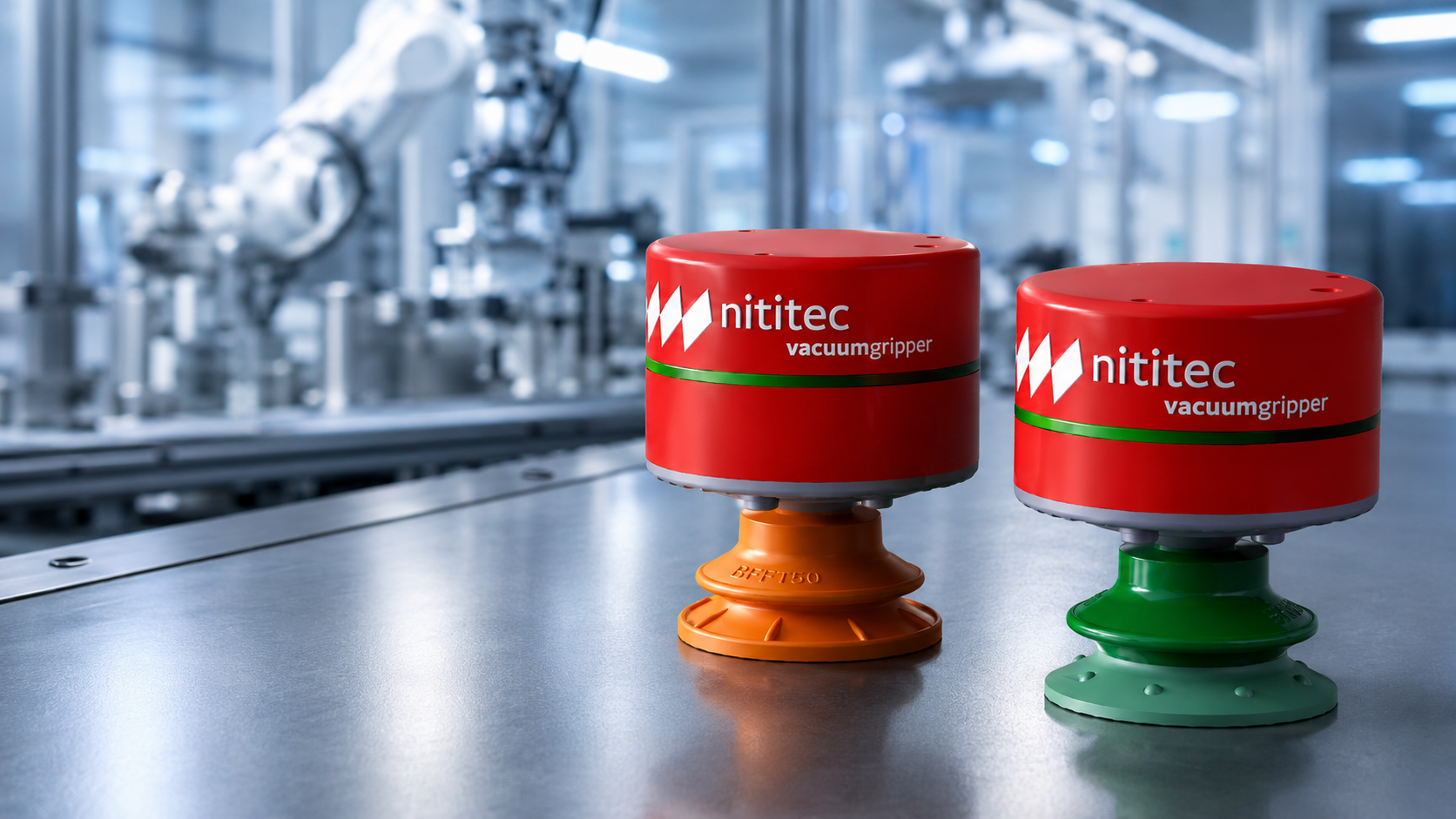
Two grippers designed for different requirements have since emerged from the original research setup.
The G-VAC PS is designed for largely sealed surfaces. PS stands for passive suction. The gripper rests on the workpiece and traps the small amount of remaining air in the system. When the robot lifts the component, a vacuum is created. No pump is required for this.
For glass, sheet metal, plastics, and other largely airtight surfaces, this principle may be sufficient. Things become more challenging when air flows in. Rough or porous materials, flexible surfaces, or other leaks require a way to compensate for losses.
The G-VAC AS was developed for this purpose. Here, a local electric pump supplements the basic principle. If the vacuum drops due to air inflow, the pump can adjust and stabilize the vacuum.
Thus, nititec vacuum gripper does not pursue the idea of a gripper that is supposed to do everything. Different components require different solutions.
Small components, many millions of cycles
Why is this relevant at all? A single ejector at a single gripping point may not initially seem like a major energy issue. It’s small, works reliably, and gets lost somewhere among the valves, hoses, and suction cups of a system.
But it rarely stops at just one cycle. One gripping operation turns into millions. One gripping point turns into several. One system turns into lines, and lines turn into entire plants.
And each time, the compressed air must be generated beforehand. It is surprising how rarely this energy consumption is even considered when designing a gripping solution. Most often, decisions are based on what works technically and has been known for years. The cost of compressed air over the entire operating period often doesn’t come into play until much later—if at all.
Even less apparent is a second dimension. Compressed air requires electrical energy. Generating less of it therefore not only reduces ongoing energy consumption; depending on the power supply, it also reduces the associated CO₂ emissions.
A single gripper won’t save the climate on its own. But it can become part of a much larger solution—precisely because hardly anyone looks for it in a small gripping application.
An Old Question Reexamined
The fact that the technology once again garnered attention at the 2026 ZVEI Electrifying Ideas Award brings the story full circle. As early as 2018, it was a closer look at a gripper principle that initially seemed unremarkable that got the Volkswagen project off the ground. Today, the same technology is prompting us to reexamine a solution that has been established for decades.
Perhaps that is precisely where its true significance lies—not in the desire to banish compressed air from factories altogether. Pneumatics is well-established, robust, and useful for many applications.
But a decision that has been taken for granted for decades now has a credible alternative. And with that, the order of the questions changes.
When tackling a new vacuum gripping task, the first question shouldn’t be: How do we generate the vacuum?
Before that, there’s another question to ask: Do we even need compressed air for this?
More about the technology
In the interview “Why Compressed Air at All?” Yannik Goergen discusses the development of the technology, G-VAC PS and G-VAC AS, the limitations of today’s electric grippers, and why nititec plans to reevaluate other gripping principles in the future.
Read the interview with Yannik Goergen
Can your gripping task work without compressed air?
The component, surface, cycle time, motion, and safety requirements determine which gripping principle makes sense. In the Application Check, nititec tests the specific application on the actual component and documents what works—and where the limits lie.