Why Use Compressed Air at All? An Interview with Yannik Goergen

Vacuum gripping without pneumatics—for Yannik Goergen, this idea began long before he founded nititec vacuum gripper. Volkswagen took notice of the technology in 2018, and a research project followed as part of the “Factory of the Future” initiative. In this interview, Goergen explains why the path to an electric vacuum gripper was more difficult than expected, when he realized that a company could emerge from this, and why vacuum gripping is just the beginning for him.
Mr. Goergen, you say that with vacuum gripping, money is being blown out the window with compressed air. That sounds pretty provocative.

It is. But that’s exactly how I feel about it.

What bothers you about it?

We’ve known for years that compressed air is a very expensive form of energy. Yet its use in vacuum gripping is rarely questioned. Compressed air is forced through an ejector with every gripping cycle. Year after year.

And at the same time, the purchasing department is haggling over every single euro elsewhere. That doesn’t add up to me.

So why does pneumatics persist so stubbornly?

Because it works and because everyone is familiar with it. Design engineers know it, machine builders know it, and the components are readily available. That’s understandable, in a way.

But there’s a second point as well.

What is it?

Many people have already seen or tried electric vacuum grippers. And these systems have limitations that make them of little interest for high-speed industrial applications. The systems are either too heavy, too large, or simply too slow at gripping and releasing the workpiece.

This quickly leads to the conclusion: “We know about electric ones. They don’t work.”

Is that really your experience?

Yes. We talk to someone about pneumatic-free vacuum gripping, and the first response we get is: “We’ve seen that—it doesn’t work.”

But that person doesn’t even know our technology at all!

That’s probably one of our biggest hurdles. People apply their existing experience to a completely different technical solution.

When did you yourself start looking at vacuum gripping differently?

Our relationship with Volkswagen dates back to 2018. Volkswagen had first seen the technology at the Hannover Messe that year.

A few years later, this led to a joint research project between ZEMA and Volkswagen as part of the “Factory of the Future” initiative.

What was the goal of this project?

The bistable concept for vacuum gripping was to be further developed to meet Volkswagen’s requirements.

It was no longer just a matter of whether a physical principle worked. Suddenly, we had specific requirements regarding mechanics, leakage, safety, electronics, interfaces…

And what was the end result?

A gripping system with four grippers. It allowed us to grasp a door panel, move it, and set it down again—all purely electrically and at a rate of about ten picks per minute.

For us, that was the decisive proof: the principle works not only in the lab.

What was your role at the time?

I was a group leader at the department and oversaw the project as project manager.

What was the biggest technical challenge?

Designing the bistability to be reliable, robust, and ideally insensitive to tolerances.

That really kept us busy. We tried out many approaches and then discarded them. Some worked in principle but weren’t robust enough. Others were too complicated.

Was there ever that one moment when you thought, “Now we’ve got it”?

Yes. When we found the technical solution for bistability that we use today.

Why that particular solution?

Because it proved to be robust and scalable. From that point on, it was clear to me: We can actually build a product on this.

When did this technical conviction turn into the idea of founding a company?

Volkswagen was an important sign for me in that regard.

Back then, VW supported us very intensively in our search for investors and also guided us in working with suppliers. When an industry partner puts so much energy into advancing a technology, you eventually start to think about it differently.

That’s when it dawned on me: There seems to be a market for this.

Still, it took some time before nititec was founded.

Of course. There’s a big difference between a successful research project and a company.

In mid-2025, with the support of a visionary technology investor, we finally spun off nititec vacuum gripper. That opened up a whole new range of possibilities for us to further develop the technology and the products.

How much does today’s gripper still have in common with the original system?

The basic principle has remained the same. In terms of design, quite a bit has changed.

How can you tell?

A very simple example is the suction cup. In the original gripper, it was firmly integrated into the system.

Today, we provide a connector on the gripper. Standard suction cups available on the market can be used there. That may sound like a minor detail, but it’s actually quite important for the application.

Why?

Every surface is different—metal, glass, wood. Smooth and clean, or dusty, oily. This allows the customer to freely select a suitable suction cup and adapt the gripper much more precisely to their specific application.

Now, specifically, how does the G-VAC PS generate the vacuum?

When lifting the component.

PS stands for passive suction. So, no active suction. The gripper rests on the workpiece, locks into place, and thereby traps the small amount of remaining air in the system. The moment the robot arm lifts the component, negative pressure is created—without any pump at all. This works very well on smooth surfaces.

Does the G-VAC AS therefore use active suction?

That’s right. We’ve integrated a local pump there. Because we’re addressing applications involving leakage.

If air flows over the workpiece, the pump can adjust and stabilize the vacuum. This allows us to tackle applications for which the PS principle alone wouldn’t be suitable.

How important is speed with these types of electric grippers?

Very important. But interestingly, the problem isn’t necessarily where many people first suspect it to be.

Oh, really? Where, then?

When releasing the workpiece.

When the gripper is placed on the workpiece, the air can escape from the suction cup relatively quickly. The critical point with electric solutions comes later, when the component needs to be released.

Why?

Because the air has to flow back into the system.

If there isn’t a truly fast way to do this, essentially only the workpiece’s own weight is working against the vacuum. Then it can take several seconds before the part is actually released.

In a high-speed automation system, several seconds is, of course, an eternity.

And with your gripper?

As soon as we unlock the system, the part is released almost immediately.

That’s exactly what enables high cycle rates. It’s not just about gripping quickly. You have to be able to release just as quickly.

Looking a few years ahead: What do you envision nititec vacuum gripper becoming?

Our goal isn’t simply to keep building new vacuum grippers. Our goal is to rethink gripping and question things that are taken for granted today.

Right now, we’re doing that with vacuum gripping.

But you can already see the next topic, right?

Yes. With our shape-memory actuators, we can do more than just create a vacuum suction cup. We can also use them to open and close a gripper. One area is tactile gripping.

That has absolutely nothing to do with vacuum.

What would you like to do differently there?

For one thing, parallel or pincer grippers can also be implemented using our actuator instead of conventional motors and gearboxes. That saves weight and reduces wear-prone mechanical components.

But I don’t want a gripper that just grabs blindly. I want it to sense what’s happening between its fingers. How tightly am I holding the component? Is it starting to slip? Do I need to react?

With the sensor technology available within our corporate group, we can capture that kind of information. It gets interesting when the gripper can draw immediate conclusions from it.

Where do you see applications for this?

Bin picking is an obvious example. There, you have very different gripping situations, yet you still want to know for sure whether the part is really being held securely.

And in the long term, of course, we’re also thinking about hand-like systems.

So, humanoids?

That’s certainly an area where such technologies could become interesting at some point. The topic is currently receiving a tremendous amount of attention.

We’re still in the very early stages. But it’s interesting that some key players in the industry have already taken notice of our technology and reached out to us.

I wouldn’t read too much into it at this point, though.

What would you like to see change in two or three years?

I’d like to see gripping technology no longer chosen simply out of habit.

If pneumatics is the best solution for a task, that’s perfectly fine. But I’d like people to ask first whether it’s even necessary.

That’s exactly what we mean by “Rethinking Gripping.”
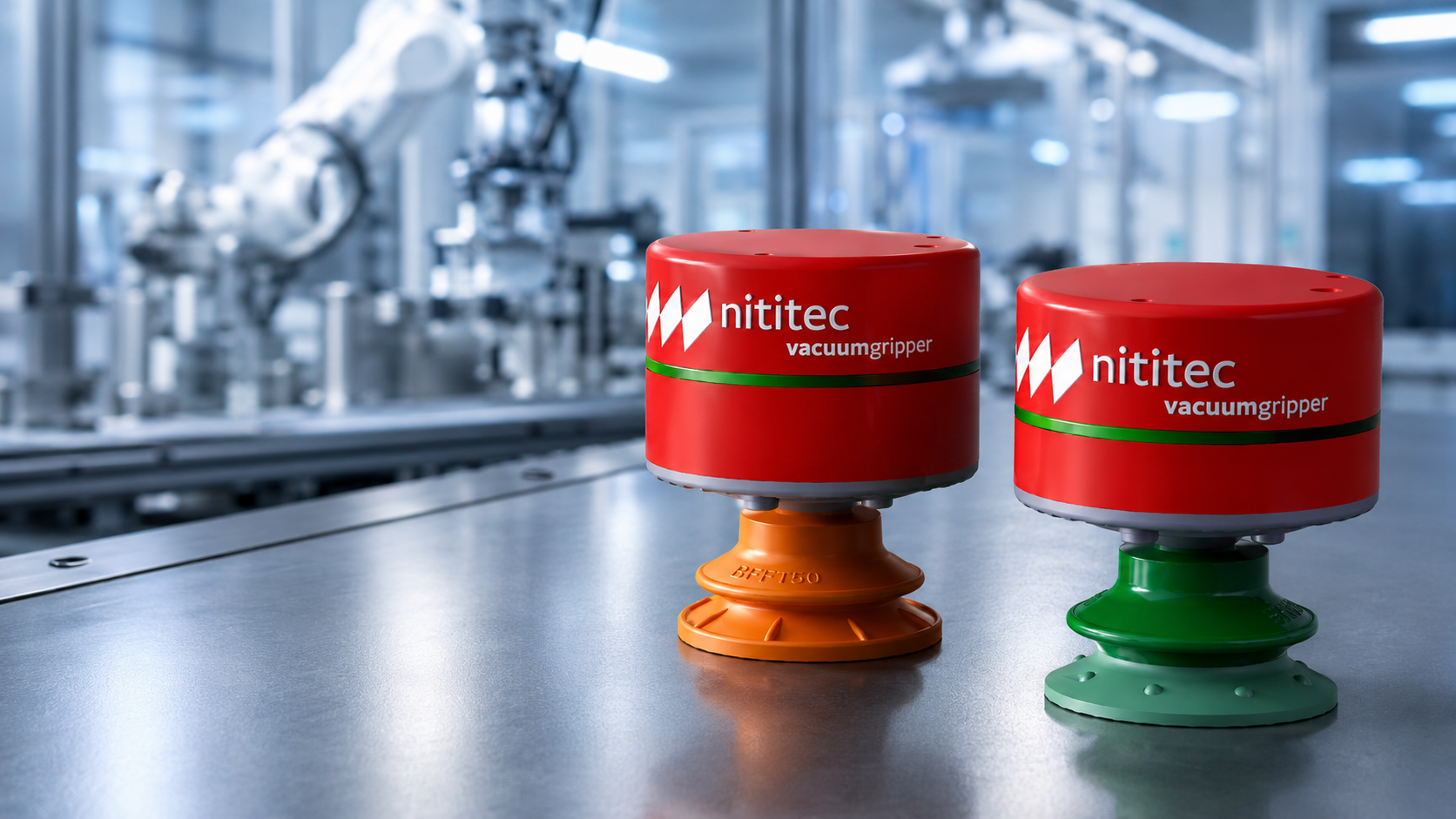
Pneumatic-Free Vacuum Gripping: The Unassuming Alternative

At the 2026 ZVEI Electrifying Ideas Award, ZeMA’s fully electric gripping technology made it to the top three finalists. It did not win. At first glance, a small vacuum gripper seems rather unremarkable next to the big issues of industrial energy efficiency. But that is precisely where its story lies: What may seem insignificant at a single gripping point is repeated millions of times in automated systems. And, of all things, an energy source that has been taken for granted for decades is rarely questioned in principle: compressed air.

Reaching the finals was not without impact. A company that is now discussing a specific application with nititec vacuum gripper first became aware of the technology through the award. It wasn’t the first time someone had taken a closer look. Eight years earlier, something similar happened at the Hannover Messe.

From Smart Wires to Vacuum Grippers

It didn’t start with a gripper, but with research. At Saarland University and within the ZeMA research network, Prof. Stefan Seelecke and Prof. Paul Motzki were studying shape-memory alloys and exploring how their unique properties could be harnessed for compact mechatronic drives.

Nickel-titanium plays a central role. When a thin wire made of this alloy is heated by a short electrical pulse, its internal structure changes and it shortens. In the process, it generates surprisingly high forces within a very small space.

This research gave rise to various drive concepts. One of them led to vacuum gripping.

Volkswagen saw the first prototype featuring this technology at the 2018 Hannover Messe and took notice. At that time, it was not yet foreseeable that a company would emerge from it years later. But one question was on the table: Could the research principle be used to develop a gripping technology that works under industrial conditions?
The basic physical concept behind it is surprisingly old.

Actually, any suction cup can do it

No one needs to connect a suction cup on a glass pane to a compressed air line. You press it against the surface, air escapes, the volume is sealed, and the resulting pressure difference holds it in place. Everyone knows this principle. So why, when it comes to automated vacuum gripping, have people been thinking for decades about how the vacuum is generated? Most often with compressed air and an ejector?

The answer lies less in physics than in automation. A person presses a suction cup against the glass and later pulls it off at the edge. A robot cannot do that. It needs a repeatable technical sequence. When the suction cup is applied, air must escape as quickly as possible. Afterward, the system must close and reliably maintain the vacuum during movement. At the release point, air must be allowed to re-enter just as quickly so that the component is released immediately.

And not just once. But ten, twenty, or thirty times per minute. Here, a simple physical principle became an engineering challenge.

Switch. And then do nothing more

For the switching process, the researchers used a nickel-titanium actuator. A short electrical pulse heats the shape-memory wire. It shortens and generates the force with which the system changes its state.

The greater challenge lay in maintaining this state afterward. The design had to be able to reliably assume two stable switching states without requiring a constant supply of energy. The developers refer to this as bistability.

Some worked in principle but proved not to be robust enough. Others were too complicated to later develop into a scalable product. At this point, the research team had to do something that is part of everyday life in development departments: let go of ideas, even though they were technically interesting.

Then the team found the solution that proved to be both robust and scalable. This did not yet turn an interesting property of a smart material into an industrial gripper. But one of the key hurdles had been cleared.

Volkswagen Turns Research into an Industrial Project

A few years after the initial contact at the Hannover Messe, a joint research project between the ZeMA Institute in Saarbrücken and Volkswagen was launched as part of Volkswagen’s “Factory of the Future” initiative.

Now the bar had been raised.

It was no longer enough to demonstrate that a gripping principle worked in the lab. The bistable concept had to be tailored to the specific requirements of an automaker: mechanics, leakage, safety, electronics, and interfaces were all part of the equation, as was the question of whether a reproducible gripping cycle could even be established from it.

At the time, Yannik Goergen was a group leader at the department and oversaw the project as project manager. The result was a gripping system with four grippers. It picked up a door panel, moved it, and set it down again—all electrically—about ten times per minute.

It wasn’t a production-ready product yet. But the gripper had left the lab.

The project demonstrated that the pneumatic-free principle could be applied to a real-world industrial gripping task. A research question had turned into a functioning gripping system.

“There seems to be a market here”

Technical feasibility and a viable business model are two different things. For Goergen, the second important signal therefore came once again from Volkswagen. The automaker provided the team with extensive support in their search for investors and established contacts with suppliers. This changed their perspective on their own development. “There seems to be a market out there,” Goergen says today, describing that moment.

Nevertheless, there was still a long way to go before it actually became a company. In mid-2025, nititec vacuum gripper was spun off as a startup, backed by a technology investor to support the further development of technology and products.

The research project was complete. The development of the gripper was not.

Without a pump—or with a reserve

Two grippers designed for different requirements have since emerged from the original research setup.

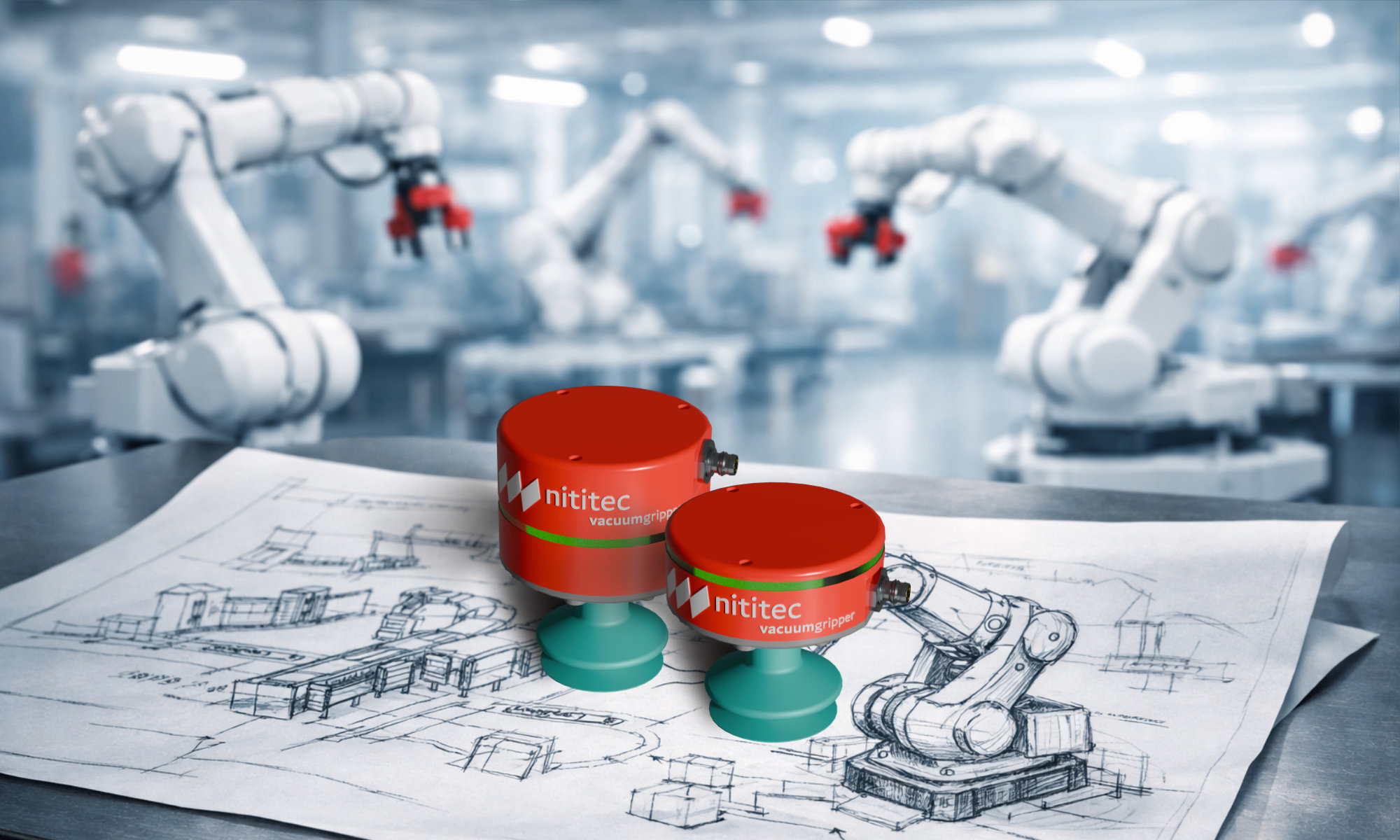
The G-VAC PS is designed for largely sealed surfaces. PS stands for passive suction. The gripper rests on the workpiece and traps the small amount of remaining air in the system. When the robot lifts the component, a vacuum is created. No pump is required for this.

For glass, sheet metal, plastics, and other largely airtight surfaces, this principle may be sufficient. Things become more challenging when air flows in. Rough or porous materials, flexible surfaces, or other leaks require a way to compensate for losses.

The G-VAC AS was developed for this purpose. Here, a local electric pump supplements the basic principle. If the vacuum drops due to air inflow, the pump can adjust and stabilize the vacuum.

Thus, nititec vacuum gripper does not pursue the idea of a gripper that is supposed to do everything. Different components require different solutions.

Small components, many millions of cycles

Why is this relevant at all? A single ejector at a single gripping point may not initially seem like a major energy issue. It’s small, works reliably, and gets lost somewhere among the valves, hoses, and suction cups of a system.

But it rarely stops at just one cycle. One gripping operation turns into millions. One gripping point turns into several. One system turns into lines, and lines turn into entire plants.

And each time, the compressed air must be generated beforehand. It is surprising how rarely this energy consumption is even considered when designing a gripping solution. Most often, decisions are based on what works technically and has been known for years. The cost of compressed air over the entire operating period often doesn’t come into play until much later—if at all.

Even less apparent is a second dimension. Compressed air requires electrical energy. Generating less of it therefore not only reduces ongoing energy consumption; depending on the power supply, it also reduces the associated CO₂ emissions.

A single gripper won’t save the climate on its own. But it can become part of a much larger solution—precisely because hardly anyone looks for it in a small gripping application.

An Old Question Reexamined

The fact that the technology once again garnered attention at the 2026 ZVEI Electrifying Ideas Award brings the story full circle. As early as 2018, it was a closer look at a gripper principle that initially seemed unremarkable that got the Volkswagen project off the ground. Today, the same technology is prompting us to reexamine a solution that has been established for decades.

Perhaps that is precisely where its true significance lies—not in the desire to banish compressed air from factories altogether. Pneumatics is well-established, robust, and useful for many applications.

But a decision that has been taken for granted for decades now has a credible alternative. And with that, the order of the questions changes.

When tackling a new vacuum gripping task, the first question shouldn’t be: How do we generate the vacuum?

Before that, there’s another question to ask: Do we even need compressed air for this?

More about the technology

In the interview “Why Compressed Air at All?” Yannik Goergen discusses the development of the technology, G-VAC PS and G-VAC AS, the limitations of today’s electric grippers, and why nititec plans to reevaluate other gripping principles in the future.

Read the interview with Yannik Goergen

Can your gripping task work without compressed air?

The component, surface, cycle time, motion, and safety requirements determine which gripping principle makes sense. In the Application Check, nititec tests the specific application on the actual component and documents what works—and where the limits lie.

<