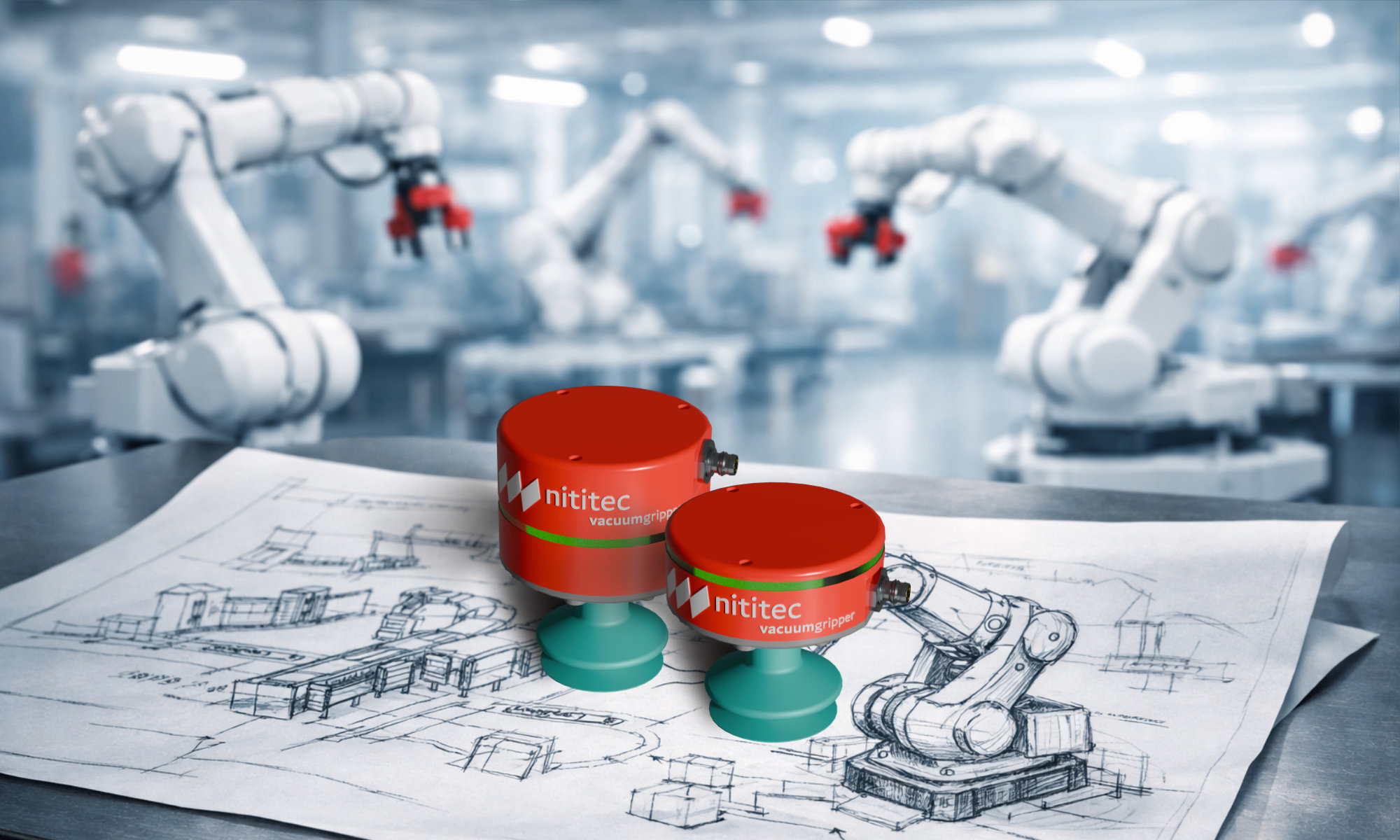
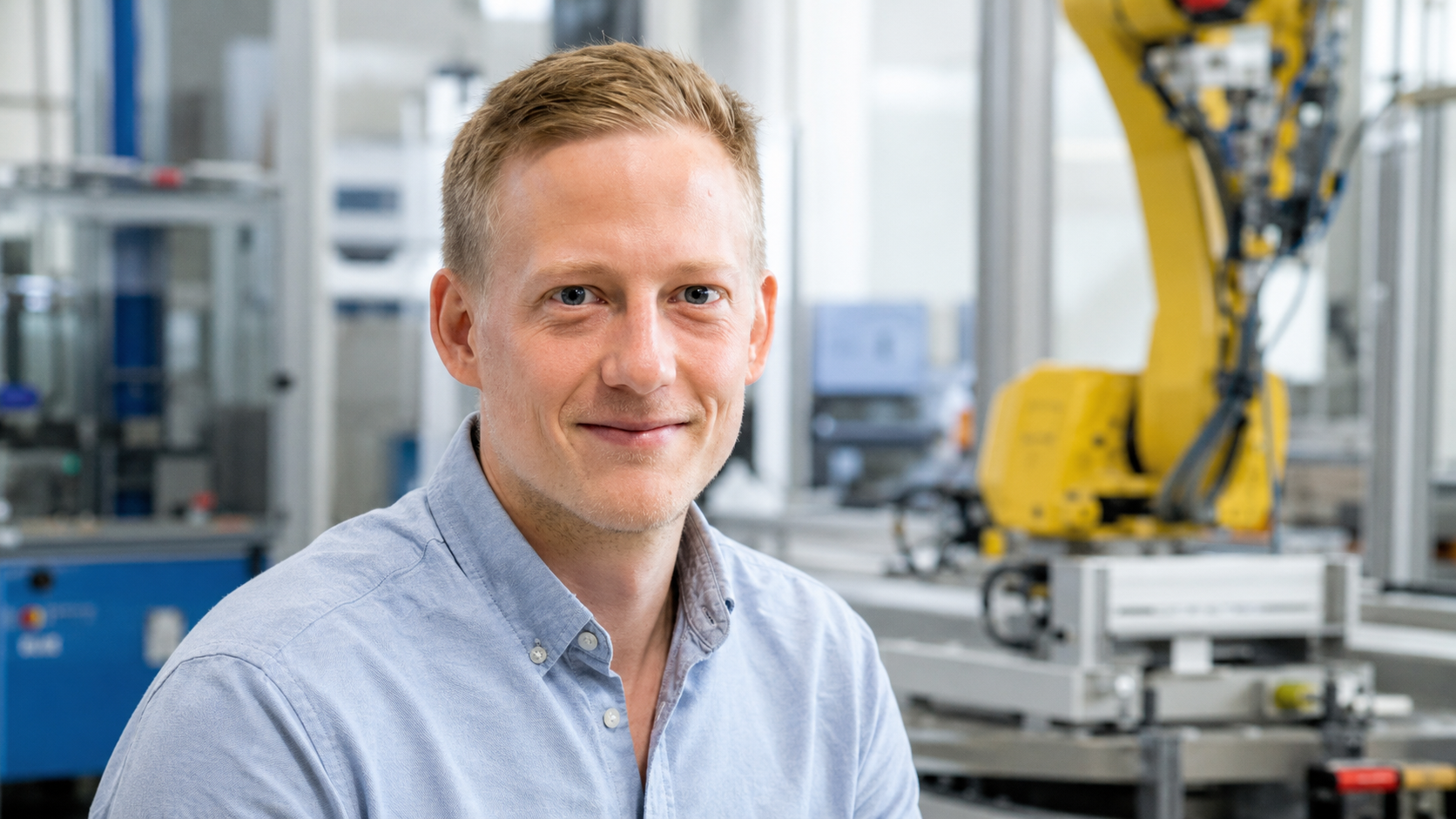
Vacuum gripping without pneumatics—for Yannik Goergen, this idea began long before he founded nititec vacuum gripper. Volkswagen took notice of the technology in 2018, and a research project followed as part of the “Factory of the Future” initiative. In this interview, Goergen explains why the path to an electric vacuum gripper was more difficult than expected, when he realized that a company could emerge from this, and why vacuum gripping is just the beginning for him.
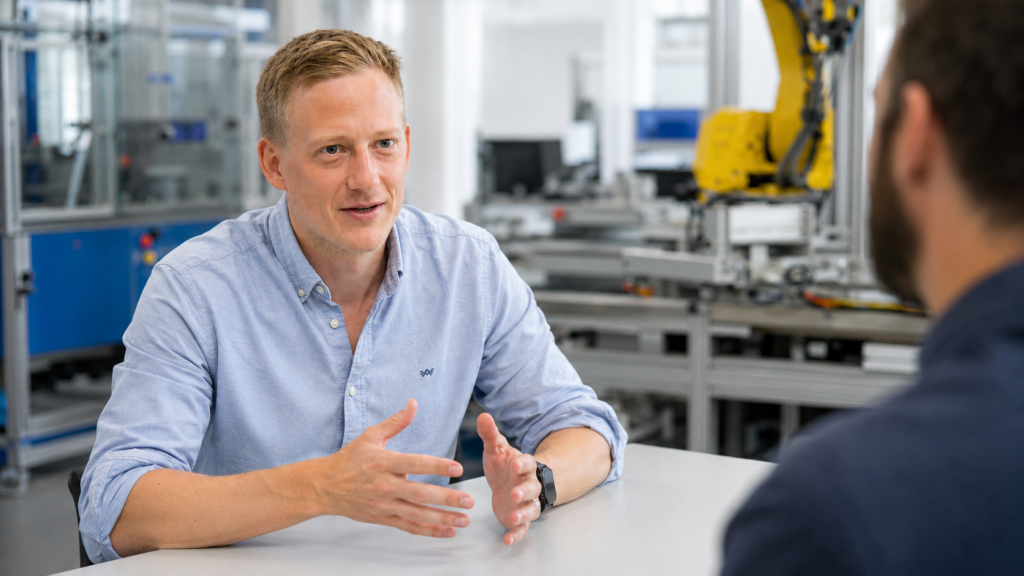
Mr. Goergen, you say that with vacuum gripping, money is being blown out the window with compressed air. That sounds pretty provocative.
It is. But that’s exactly how I feel about it.
What bothers you about it?
We’ve known for years that compressed air is a very expensive form of energy. Yet its use in vacuum gripping is rarely questioned. Compressed air is forced through an ejector with every gripping cycle. Year after year.
And at the same time, the purchasing department is haggling over every single euro elsewhere. That doesn’t add up to me.
So why does pneumatics persist so stubbornly?
Because it works and because everyone is familiar with it. Design engineers know it, machine builders know it, and the components are readily available. That’s understandable, in a way.
But there’s a second point as well.
What is it?
Many people have already seen or tried electric vacuum grippers. And these systems have limitations that make them of little interest for high-speed industrial applications. The systems are either too heavy, too large, or simply too slow at gripping and releasing the workpiece.
This quickly leads to the conclusion: “We know about electric ones. They don’t work.”
Is that really your experience?
Yes. We talk to someone about pneumatic-free vacuum gripping, and the first response we get is: “We’ve seen that—it doesn’t work.”
But that person doesn’t even know our technology at all!
That’s probably one of our biggest hurdles. People apply their existing experience to a completely different technical solution.
When did you yourself start looking at vacuum gripping differently?
Our relationship with Volkswagen dates back to 2018. Volkswagen had first seen the technology at the Hannover Messe that year.
A few years later, this led to a joint research project between ZEMA and Volkswagen as part of the “Factory of the Future” initiative.
What was the goal of this project?
The bistable concept for vacuum gripping was to be further developed to meet Volkswagen’s requirements.
It was no longer just a matter of whether a physical principle worked. Suddenly, we had specific requirements regarding mechanics, leakage, safety, electronics, interfaces…
And what was the end result?
A gripping system with four grippers. It allowed us to grasp a door panel, move it, and set it down again—all purely electrically and at a rate of about ten picks per minute.
For us, that was the decisive proof: the principle works not only in the lab.
What was your role at the time?
I was a group leader at the department and oversaw the project as project manager.
What was the biggest technical challenge?
Designing the bistability to be reliable, robust, and ideally insensitive to tolerances.
That really kept us busy. We tried out many approaches and then discarded them. Some worked in principle but weren’t robust enough. Others were too complicated.
Was there ever that one moment when you thought, “Now we’ve got it”?
Yes. When we found the technical solution for bistability that we use today.
Why that particular solution?
Because it proved to be robust and scalable. From that point on, it was clear to me: We can actually build a product on this.
When did this technical conviction turn into the idea of founding a company?
Volkswagen was an important sign for me in that regard.
Back then, VW supported us very intensively in our search for investors and also guided us in working with suppliers. When an industry partner puts so much energy into advancing a technology, you eventually start to think about it differently.
That’s when it dawned on me: There seems to be a market for this.
Still, it took some time before nititec was founded.
Of course. There’s a big difference between a successful research project and a company.
In mid-2025, with the support of a visionary technology investor, we finally spun off nititec vacuum gripper. That opened up a whole new range of possibilities for us to further develop the technology and the products.
How much does today’s gripper still have in common with the original system?
The basic principle has remained the same. In terms of design, quite a bit has changed.
How can you tell?
A very simple example is the suction cup. In the original gripper, it was firmly integrated into the system.
Today, we provide a connector on the gripper. Standard suction cups available on the market can be used there. That may sound like a minor detail, but it’s actually quite important for the application.
Why?
Every surface is different—metal, glass, wood. Smooth and clean, or dusty, oily. This allows the customer to freely select a suitable suction cup and adapt the gripper much more precisely to their specific application.
Now, specifically, how does the G-VAC PS generate the vacuum?
When lifting the component.
PS stands for passive suction. So, no active suction. The gripper rests on the workpiece, locks into place, and thereby traps the small amount of remaining air in the system. The moment the robot arm lifts the component, negative pressure is created—without any pump at all. This works very well on smooth surfaces.
Does the G-VAC AS therefore use active suction?
That’s right. We’ve integrated a local pump there. Because we’re addressing applications involving leakage.
If air flows over the workpiece, the pump can adjust and stabilize the vacuum. This allows us to tackle applications for which the PS principle alone wouldn’t be suitable.
How important is speed with these types of electric grippers?
Very important. But interestingly, the problem isn’t necessarily where many people first suspect it to be.
Oh, really? Where, then?
When releasing the workpiece.
When the gripper is placed on the workpiece, the air can escape from the suction cup relatively quickly. The critical point with electric solutions comes later, when the component needs to be released.
Why?
Because the air has to flow back into the system.
If there isn’t a truly fast way to do this, essentially only the workpiece’s own weight is working against the vacuum. Then it can take several seconds before the part is actually released.
In a high-speed automation system, several seconds is, of course, an eternity.
And with your gripper?
As soon as we unlock the system, the part is released almost immediately.
That’s exactly what enables high cycle rates. It’s not just about gripping quickly. You have to be able to release just as quickly.
Looking a few years ahead: What do you envision nititec vacuum gripper becoming?
Our goal isn’t simply to keep building new vacuum grippers. Our goal is to rethink gripping and question things that are taken for granted today.
Right now, we’re doing that with vacuum gripping.
But you can already see the next topic, right?
Yes. With our shape-memory actuators, we can do more than just create a vacuum suction cup. We can also use them to open and close a gripper. One area is tactile gripping.
That has absolutely nothing to do with vacuum.
What would you like to do differently there?
For one thing, parallel or pincer grippers can also be implemented using our actuator instead of conventional motors and gearboxes. That saves weight and reduces wear-prone mechanical components.
But I don’t want a gripper that just grabs blindly. I want it to sense what’s happening between its fingers. How tightly am I holding the component? Is it starting to slip? Do I need to react?
With the sensor technology available within our corporate group, we can capture that kind of information. It gets interesting when the gripper can draw immediate conclusions from it.
Where do you see applications for this?
Bin picking is an obvious example. There, you have very different gripping situations, yet you still want to know for sure whether the part is really being held securely.
And in the long term, of course, we’re also thinking about hand-like systems.
So, humanoids?
That’s certainly an area where such technologies could become interesting at some point. The topic is currently receiving a tremendous amount of attention.
We’re still in the very early stages. But it’s interesting that some key players in the industry have already taken notice of our technology and reached out to us.
I wouldn’t read too much into it at this point, though.
What would you like to see change in two or three years?
I’d like to see gripping technology no longer chosen simply out of habit.
If pneumatics is the best solution for a task, that’s perfectly fine. But I’d like people to ask first whether it’s even necessary.
That’s exactly what we mean by “Rethinking Gripping.”